Fisheye lenses are the rebels of the optical world. While most glass aims to correct distortion and render straight lines with clinical precision, the best fisheye lenses embrace the curve, warping reality into a spherical masterpiece. At CameraLensReviews, we believe every serious photographer should have at least one of these creative tools in their kit. Whether you are shooting extreme sports, immersive architectural interiors, or simply want to break free from the constraints of rectilinear perspective, a high-quality fisheye offers a visual signature that no other optic can replicate.
See Price on Amazon.com:
Our Top Pick: Canon EF 8-15mm f/4LValue Pick: Rokinon 12mm f/2.8High-End Pick: Sigma 15mm f/1.4 Art
When we tested the latest crop of fisheye glass in our lab and out in the field, we looked for more than just the widest angle of view. We analyzed corner sharpness—often the Achilles’ heel of these lenses—along with chromatic aberration control and build quality. A great fisheye should feel like a precision instrument, not a novelty toy. From the versatile zooms that switch between circular and diagonal fields of view to the fast-aperture primes designed for astrophotography, our selection covers the absolute peak of optical performance available in 2026.
1. Canon EF 8-15mm f/4L Fisheye USM
The King of Versatility

When we discuss the absolute gold standard for fisheye optics, the Canon EF 8-15mm f/4L remains undefeated in terms of sheer versatility. This is not just a lens; it is two lenses in one. On a full-frame body, zooming out to 8mm produces a perfectly circular image—a floating globe within a black frame that is iconic for artistic applications. Zooming in to 15mm fills the frame completely with a diagonal fisheye view (180 degrees corner-to-corner). This dual capability allows photographers to switch from abstract, planet-like compositions to immersive ultra-wide landscapes without changing lenses.
In our field tests, the build quality impressed us immediately. As an L-series lens, it features robust weather sealing and a fluorine coating on the bulbous front element, which is essential since you cannot use standard protective filters. The autofocus is snappy and silent, courtesy of the USM motor. Optically, it is razor-sharp even at f/4. While chromatic aberration can appear at the extreme edges in high-contrast scenes (like tree branches against a bright sky), it is easily correctable in post-processing. For videographers, this lens has become a staple for skate videos and music clips, cementing its place in our guide to video recording lenses.
2. Rokinon 12mm f/2.8 Full Frame Fisheye
The Best Value for Manual Focus Shooters
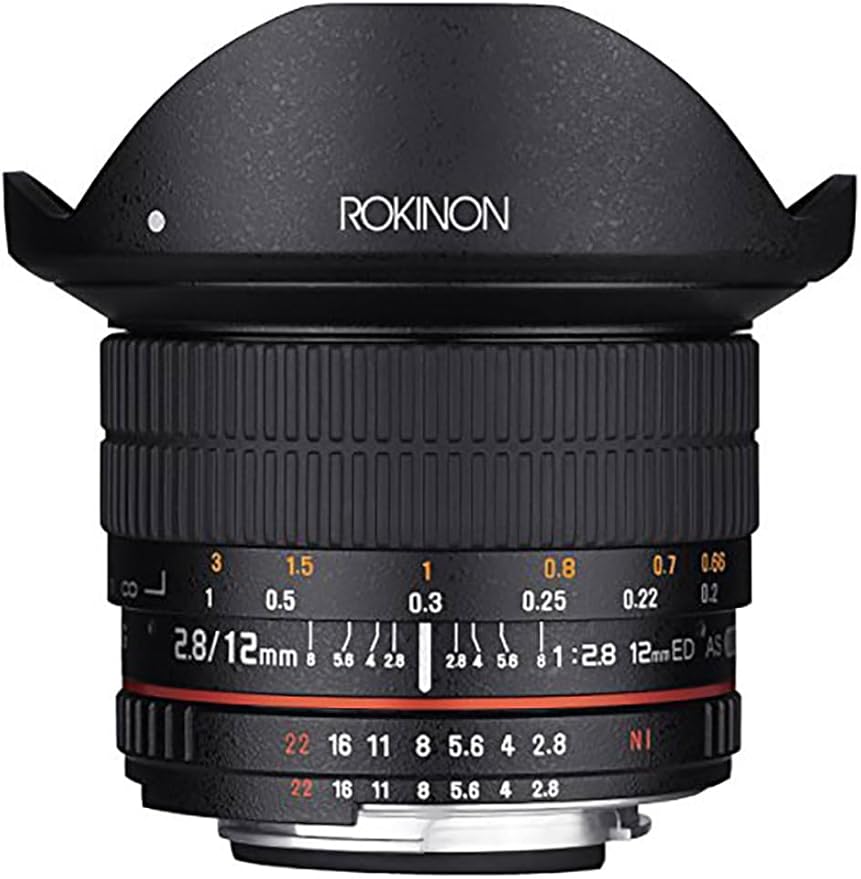
For those who find the price of premium zooms hard to swallow, the Rokinon (also branded as Samyang) 12mm f/2.8 is a revelation. This is a manual focus lens, but don’t let that deter you. With a fisheye, the depth of field is so immense that once you stop down to f/5.6 or f/8 and set focus to infinity, virtually everything from your feet to the horizon will be tack sharp. This makes it an excellent candidate for our list of budget camera lenses that don’t compromise on image quality.
What sets this lens apart is its stereographic projection. Unlike many fisheyes that squash objects at the edges, the Rokinon maintains a more natural look for subjects on the periphery, making it surprisingly usable for architectural work and real estate interiors where you want to maximize space without inducing nausea. We found the focus ring to be smooth and well-damped, providing excellent tactile feedback. While it lacks the electronic communication of other third-party lenses, the optical performance per dollar is unbeatable.
3. Sigma 15mm f/1.4 DG DN Diagonal Fisheye Art
The Modern Masterpiece for Mirrorless
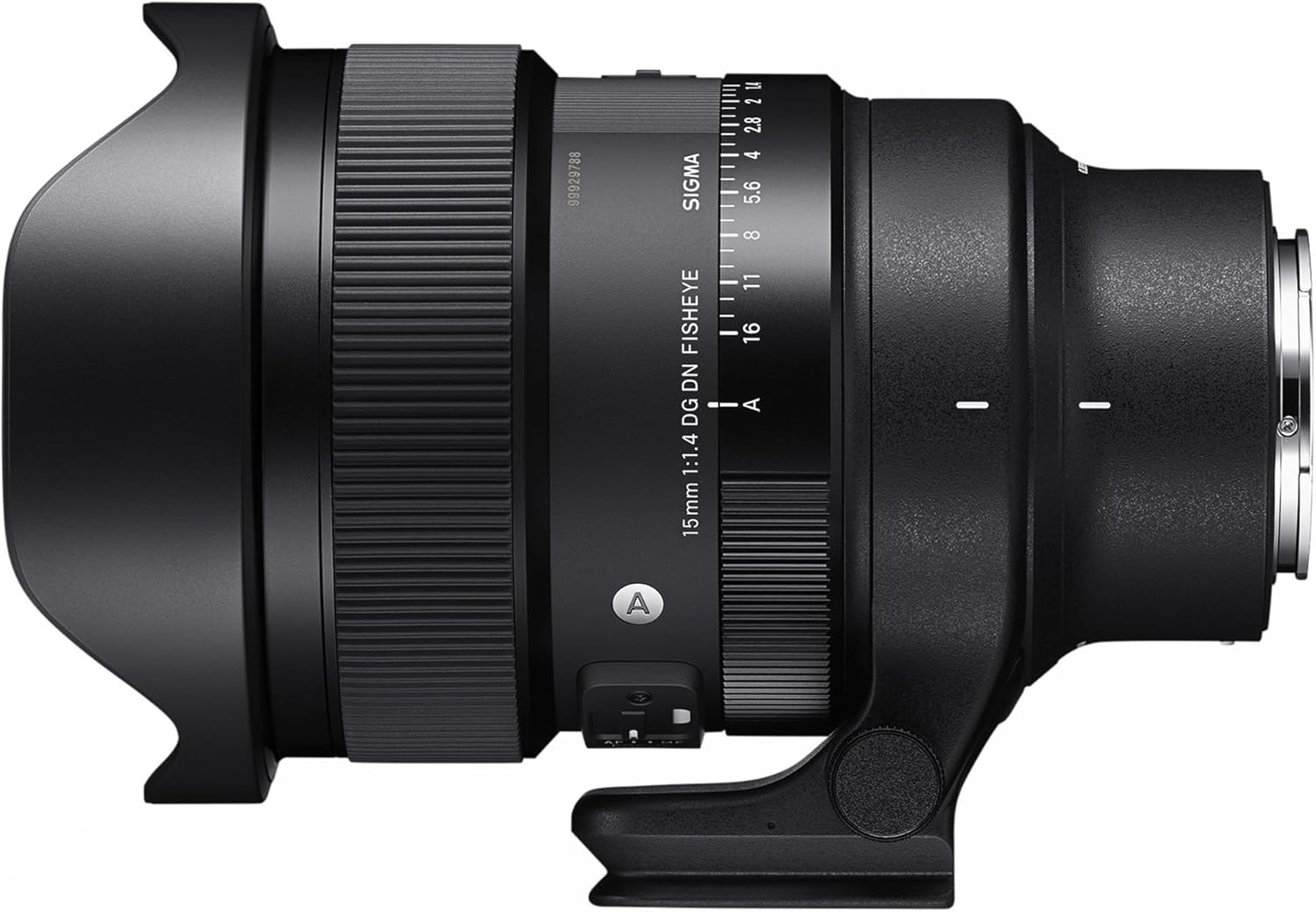
If you are shooting on a modern Sony E-mount or L-mount system, the Sigma 15mm f/1.4 DG DN Art is nothing short of an engineering marvel. This is the world’s first f/1.4 diagonal fisheye for full-frame mirrorless cameras, and it is a beast. The f/1.4 aperture is a game-changer for astrophotographers. In our testing, it sucked in light like a black hole, allowing us to keep ISO levels low while capturing the entire Milky Way arc in a single frame. This performance makes it a top contender in our discussions on landscape and astro lenses.
The lens is heavy and large, typical of the Sigma Art line, but the trade-off is optical perfection. Sharpness is consistent from center to corner, even wide open—a rare feat for a fisheye. It also features a rear filter holder for gelatin filters, a crucial feature for long-exposure work. If you are looking for the absolute highest image quality and are willing to carry the weight, this is the lens to buy.
4. Nikon AF-S Fisheye NIKKOR 8-15mm f/3.5-4.5E ED
The Gold Standard for Nikon Shooters

For Nikon users, the 8-15mm f/3.5-4.5E ED is the direct answer to Canon’s dominance in the fisheye zoom market. Like its Canon counterpart, it offers both circular (at 8mm) and full-frame diagonal (at 15mm) perspectives. We were particularly impressed by the edge-to-edge clarity this lens delivers. Nikon’s Extra-low Dispersion (ED) glass effectively minimizes color fringing, which is often a plague on wider lenses.
One subtle but important feature we noticed during handling is the durability of the lens barrel and the smoothness of the zoom ring. It feels like a professional tool designed for years of abuse. While the variable aperture (f/3.5-4.5) is slightly slower than the Canon’s constant f/4, in real-world use, the difference is negligible unless you are shooting in extremely low light. For Nikon DSLR users (or Z users with an FTZ adapter), this is the definitive fisheye choice.
5. Panasonic Lumix G Fisheye 8mm f/3.5
The Micro Four Thirds Marvel

Micro Four Thirds users often prioritize portability, and the Panasonic Lumix G Fisheye 8mm f/3.5 delivers exactly that. It is incredibly small and lightweight, making it the perfect companion for travel photography or for flying on a drone. Despite its diminutive size, it packs a punch optically. We found it to be exceptionally sharp in the center, with very respectable corner performance for such a tiny optic.
Because of the 2x crop factor of Micro Four Thirds sensors, this 8mm lens provides a 16mm equivalent field of view, which is a classic diagonal fisheye look. It’s a favorite among underwater photographers due to its compatibility with many compact dome ports. If you are looking for a first lens upgrade to expand your creative horizons on an Olympus or Panasonic body, this is a fun and high-quality addition.
Conclusion
Choosing the best fisheye lens comes down to understanding your creative needs. If you need the flexibility to switch between circular and diagonal views, the Canon EF 8-15mm f/4L and Nikon AF-S 8-15mm are the undisputed champions of the genre. For mirrorless users seeking the absolute highest resolution for astrophotography, the Sigma 15mm f/1.4 Art is in a league of its own. Meanwhile, budget-conscious photographers can achieve stunning professional results with the manual focus Rokinon 12mm f/2.8.
Fisheye lenses are specialized tools, but they open up a world of perspective that standard wide-angle lenses simply cannot touch. They force you to get close, to rethink composition, and to embrace the distortion rather than fight it. We hope this guide helps you find the perfect glass to round out your kit.
Frequently Asked Questions
What is the difference between a circular and a diagonal fisheye lens?
A circular fisheye lens projects a complete 180-degree circle in the center of the frame, leaving the corners black. A diagonal fisheye covers the entire rectangular sensor, providing a 180-degree field of view only across the diagonal, resulting in a full-screen image with distorted edges.
Why would I choose a fisheye lens over a standard ultra-wide angle lens?
You choose a fisheye for its unique distortion and wider field of view. While rectilinear ultra-wide lenses keep lines straight (great for architecture), fisheye lenses bend lines to capture a wider hemisphere, creating dynamic, immersive, and artistic effects that standard lenses cannot achieve.
Can I correct fisheye distortion in post-processing?
Yes, most modern editing software like Adobe Lightroom and Photoshop includes lens profiles that can ‘de-fish’ images, converting them into rectilinear wide-angle shots. However, this process stretches the corners significantly, which may result in a loss of sharpness at the edges.
Are fisheye lenses good for astrophotography?
Absolutely. Fisheye lenses are excellent for astrophotography because their massive field of view allows you to capture the entire Milky Way arc and more of the sky in a single frame. Fast apertures, like f/1.4 or f/2.8, are preferred to keep ISO levels low.
Do fisheye lenses work on crop sensor (APS-C) cameras?
Yes, but the effect changes. A full-frame circular fisheye might act like a diagonal fisheye on a crop sensor because the smaller sensor crops out the black edges. Ideally, you should buy a fisheye designed specifically for your sensor size to get the intended effect.