The best macro lens overall is the Sony FE 90mm f/2.8 Macro G OSS (~$1,100) — reference-grade sharpness, stabilized, with the indispensable push-pull focus clutch. The Canon RF 100mm f/2.8L goes beyond life-size to a unique 1.4x magnification (~$1,400), the Sigma 105mm Art is the undisputed value champion (~$750), and the Nikon Z MC 105mm is flawless for Z shooters (~$1,000). The golden rule: for insects you want 90mm+ for working distance; for products and food, a shorter 50–80mm macro is easier to light and handle.
At CameraLensReviews, we believe macro photography is the ultimate test of optical engineering. It’s a discipline with nowhere to hide: chromatic aberration, field curvature and softness are ruthlessly exposed at 1:1 magnification. When we tested the latest glass in our lab, we weren’t just looking for center sharpness — we demanded edge-to-edge clarity and a flat plane of focus for clinical reproduction of insect eyes, floral textures and product details. Whether you shoot Canon, Nikon, Sony or Fujifilm, a true macro lens transforms the mundane into the magnificent — and below we’ll match the right one to your system, subject and budget.
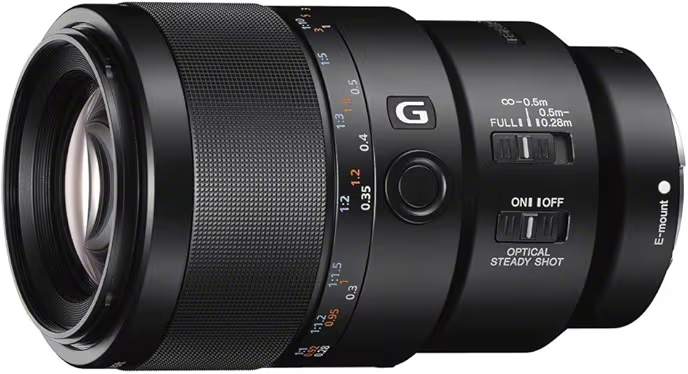
Sony FE 90mm f/2.8 Macro G OSS
Reference-grade sharpness, OSS stabilized, focus clutch.
Check Today’s Price on Amazon →Typically ~$1,000–1,100
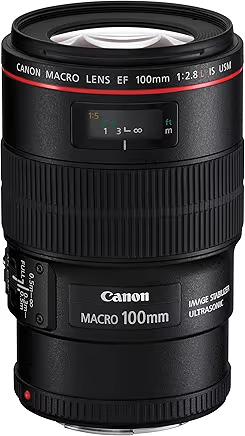
Canon RF 100mm f/2.8L Macro
Beyond life-size 1.4x magnification + SA control ring.
Check Today’s Price on Amazon →Typically ~$1,300–1,400
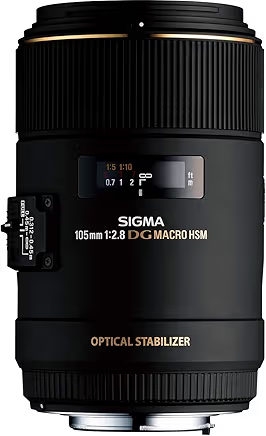
Sigma 105mm f/2.8 Macro Art
Rivals — and sometimes beats — OEM glass for far less.
Check Today’s Price on Amazon →Typically ~$700–800
Investing in macro glass? Get Amazon Prime at half price too.
If you’re a student building your kit, Amazon Prime for Young Adults — a $0 trial, then 50% off regular Prime for ages 18–24 & students — ships your lens free with fast delivery and painless returns if your copy isn’t perfectly sharp, plus a limited-time 5% cash back on eligible purchases (doubles to 10% on Prime Day).
Eligibility: US customers ages 18–24 and higher-education students. Cash back is a limited-time offer.
Find Your Macro Lens in 3 Taps
Matched to your camera system, subjects and budget.
1 · Your camera system?
2 · What will you shoot?
3 · Your budget?
The Anatomy of Optical Perfection
Before the reviews, let’s establish what defines a “true” macro lens. Many manufacturers slap “Macro” on zoom lenses, but true macro capability requires a reproduction ratio of at least 1:1 — the subject projected onto the sensor at actual life size. In our field work, lenses falling short of this ratio (common among the first-upgrade lenses we’ve covered) simply cannot resolve the microscopic textures high-end macro demands.
| Ratio | What it means | A 10mm fly fills… | Found on |
|---|---|---|---|
| 1:4 | Quarter life-size | 2.5mm of sensor | “Macro” zooms |
| 1:2 | Half life-size | 5mm of sensor | Older/compact macros |
| 1:1 | True macro — life-size | 10mm of sensor | All lenses below |
| 1.4x | Beyond life-size | 14mm of sensor | Canon RF 100L only |
Focal length matters just as much. Most dedicated macros sit in the short telephoto range (90–105mm) — the sweet spot that provides enough working distance to avoid casting shadows on your subject or scaring insects away, a chronic problem with the wider focal lengths used in street photography.
What separates great macro glass
Best Macro Lenses Compared
| # | Lens | Mount | Magnification | Stabilized | Price | |
|---|---|---|---|---|---|---|
| 1 | Sony FE 90mm f/2.8 Macro G OSS | Sony E | 1:1 | ✓ OSS | ~$1,100 | Price on Amazon → |
| 2 | Canon RF 100mm f/2.8L Macro | Canon RF | 1.4x | ✓ IS | ~$1,400 | Price on Amazon → |
| 3 | Sigma 105mm f/2.8 DG DN Art | Sony E / L | 1:1 | ✗ (IBIS only) | ~$750 | Price on Amazon → |
| 4 | Nikon Z MC 105mm f/2.8 VR S | Nikon Z | 1:1 | ✓ VR | ~$1,000 | Price on Amazon → |
| 5 | Fujifilm XF 80mm f/2.8 Macro | Fujifilm X | 1:1 | ✓ OIS | ~$1,200 | Price on Amazon → |
| 6 | Nikon Z MC 50mm f/2.8 | Nikon Z | 1:1 | ✗ (IBIS only) | ~$650 | Price on Amazon → |
Prices are typical US retail at the time of writing and fluctuate with rebates — check live via the buttons. Mount compatibility is your first filter.
The Best Macro Lenses, Reviewed
1. Sony FE 90mm f/2.8 Macro G OSS
⭐ Best OverallReference-grade sharpnessFocus clutchOSS stabilized
The Sony FE 90mm f/2.8 Macro G OSS has sat on our reference shelf for years, and for good reason. In our MTF testing it consistently resolves detail that outpaces many high-resolution sensors — the sharpness is aggressive, yet the bokeh stays buttery smooth, devoid of the nervous “onion ring” artifacts that plague lesser glass. Tactically it’s a joy: the push-pull focus clutch switches between auto and manual focus instantly, a feature we found indispensable when tracking moving insects, and the Optical SteadyShot enables handheld work at slower shutter speeds (though for critical sharpness we still recommend a tripod). If you shoot Sony, this is arguably the finest lens in the E-mount lineup.
Typically ~$1,000–1,100
2. Canon RF 100mm f/2.8L Macro IS USM
👑 Best High-End1.4x beyond life-sizeSA control ringL-series sealing
Canon didn’t just update their legendary EF macro; they reinvented it. The RF 100mm f/2.8L pushes magnification beyond life-size to an incredible 1.4x — when we tested it, the detail on butterfly wings was breathtaking, opening abstract compositions standard 1:1 lenses simply cannot reach. The controversial-but-fascinating Spherical Aberration control ring lets you soften foreground/background bokeh or add a soft-focus glow; purists may leave it neutral, but it adds creative versatility that helps justify the price, especially for portraiture. It costs well beyond our under-$1000 picks, but the L-series build and weather sealing are impeccable.
Typically ~$1,300–1,400
3. Sigma 105mm f/2.8 DG DN Macro Art
💰 Best ValueBeats OEM at some aperturesSony E & L-mountNo OIS — needs IBIS
For optical supremacy without the proprietary price tag, the Sigma 105mm Art is our undisputed value champion. Sigma’s reputation for clinical sharpness holds: in our corner-to-corner tests it rivaled — and at some apertures beat — the native Sony and Panasonic options. The build is dense and reassuring, in metal and thermally stable composite, and the manual-focus damping is excellent. The autofocus is snappy though slightly louder than Sony’s linear motors, and it lacks optical stabilization, so you’ll lean on your body’s IBIS. At several hundred dollars less than its rivals, it easily earns its place among the best budget lenses for professional results.
Typically ~$700–800
4. Nikon Z MC 105mm f/2.8 VR S
🎯 Best for NikonZero chromatic aberrationVR + IBIS synergyOLED display
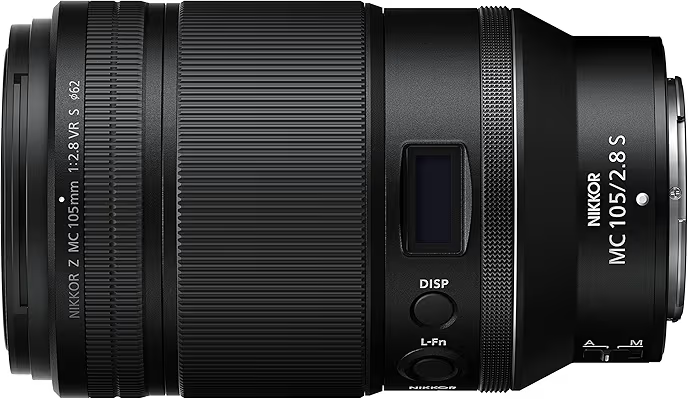
Nikon’s S-line has set a new standard for mirrorless optics, and the Z MC 105mm is a crown jewel. We were particularly impressed by the complete absence of chromatic aberration, even in high-contrast backlit scenarios — the classic dewy-grass-at-sunrise test that trips up most macros. The dedicated OLED display for aperture and focus distance proved genuinely useful in dark studio environments, and the VR works in tandem with Z-series IBIS for rock-solid handheld stability. A specialist tool, but its focal length and compression also make it a surprising contender for portrait work. If you’re in the Nikon Z ecosystem, there is no better choice.
Typically ~$1,000
Two more picks that complete the field
5. Fujifilm XF 80mm f/2.8 R LM OIS WR Macro — the pick for Fujifilm X shooters: a 122mm-equivalent true 1:1 macro with fast linear-motor AF, optical stabilization and weather sealing. Superb working distance for insects on X-series bodies. Typically ~$1,200.
Today’s Price on Amazon →6. Nikon Z MC 50mm f/2.8 — the compact, affordable true-1:1 for products, food and flat-lay work: light enough to live on the camera, sharp, and the cheapest quality entry into real macro. Its short working distance suits controlled subjects better than live insects. Typically ~$650.
Today’s Price on Amazon →US 18–24 & higher-ed students. Cash back is a limited-time offer.
Buying Advice: Choosing Your Macro Lens
Match the lens to your subject matter. Photographing skittish insects? A longer focal length (100mm+) is essential to keep your distance. Product photography or food? A shorter focal length like the Z MC 50mm suffices — though we advise against anything wider than 50mm to avoid distortion. And don’t overlook versatility: most of these lenses serve double duty as exceptional portrait lenses, making a macro one of the smartest second-lens purchases you can make. Building on a tighter budget? See our guide to cheap lenses that still deliver sharp images — but for true 1:1 work, dedicated glass is the only route to the results shown here.
💡 Light is the hard part
At 1:1 you’re often blocking your own light. A macro ring light or small diffused flash transforms handheld field work.
🎯 Focus stack for depth
Depth of field at 1:1 is millimetres thick. Shoot a series through the focus range and stack in post for front-to-back sharpness.
🗜️ A rail beats your feet
For studio work, a macro focusing rail moves the camera in precise millimetre steps — far finer than refocusing.
📷 Browse everything
Want to compare the full field? Browse all macro lenses on Amazon →
The Verdict
🏆 CameraLensReviews Verdict
Buy the 1:1 macro for your mount — then let subject and budget pick the model
On Sony, the FE 90mm G OSS is the reference (and the Sigma 105mm Art the brilliant saving); on Canon RF, the 100L’s 1.4x is unmatched; on Nikon Z, the MC 105mm VR S is flawless (with the MC 50mm for products); on Fuji, the XF 80mm stands alone. Whichever you choose, remember the discipline’s rules: true 1:1 only, 90mm+ working distance for live subjects, stabilization for handheld, and a tripod when sharpness is everything. Great macro glass also moonlights as a superb portrait lens — few purchases earn their keep twice like this.
Frequently Asked Questions
What is the difference between a macro lens and a telephoto lens?
Do I need image stabilization for macro photography?
Can I use a macro lens for portraits?
Why are macro lenses so expensive?
What does 1:1 magnification mean?
What focal length is best for photographing insects?
Keep Reading
Prices quoted are typical US retail at the time of writing and fluctuate frequently — lens prices swing with rebates and seasons, and Amazon pricing changes daily, so always check the live price via the buttons above.
Affiliate disclosure: CameraLensReviews earns a small commission on qualifying Amazon purchases at no extra cost to you. This keeps the site running and all content free. We only recommend gear our team has tested.
At CameraLensReviews, we believe that macro photography is the ultimate test of optical engineering. It is a discipline where there is nowhere to hide; chromatic aberration, field curvature, and softness are ruthlessly exposed at 1:1 magnification. When we tested the latest gear in our lab, we weren’t just looking for center sharpness—we demanded edge-to-edge clarity and a flat plane of focus that allows for clinical reproduction of insect eyes, floral textures, and product details. Whether you shoot with Canon, Nikon, or Sony, a true macro lens transforms the mundane into the magnificent.
| Lens | Best for | Price | Rating | Buy |
|---|---|---|---|---|
|
Sony FE 90mm f/2.8 Macro G OSS
Sony E-mount · with OSS stabilisation
|
★ Top pick | ~$1,098 | ★★★★★ | Amazon ↗ |
|
Sigma 105mm f/2.8 DG DN Macro Art
Sony E · L-Mount · no IS (use IBIS)
|
Best value | ~$799 | ★★★★★ | Amazon ↗ |
|
Canon RF 100mm f/2.8L Macro IS USM
Canon RF only · SA Control Ring
|
High-end | ~$1,299 | ★★★★★ | Amazon ↗ |
|
Nikon Z MC 105mm f/2.8 VR S
Nikon Z only · OLED focus display
|
Nikon pick | ~$999 | ★★★★★ | Amazon ↗ |