
In the pursuit of clinical perfection, modern optics have largely eliminated the flaws that once gave images character. As the Lead Optical Engineer at CameraLensReviews, I often spend my days measuring MTF charts and criticizing corner softness. However, there comes a moment in every photographer’s journey when clinical sharpness feels sterile. This is where the best prism lens and creative filters come into play. By deliberately introducing refraction, light leaks, and controlled distortion, these tools allow us to break the rules of physics to create something emotionally resonant rather than just technically correct.
When we tested the latest wave of prism filters, we weren’t looking for edge-to-edge sharpness. Instead, we evaluated the quality of the optical glass (typically K9 or BK7), the fluidity of the rotating mechanisms, and the “flavor” of the refractive index. Whether you are shooting music videos, abstract portraits, or surreal street scenes, a high-quality prism filter can transform a standard 50mm perspective into a kaleidoscopic masterpiece. Below, we detail the top optical tools that earned a permanent spot in our camera bags.
See Price on Amazon.com:
Our Top Pick: Prism Lens FX Linear PrismValue Pick: K&F Concept KaleidoscopeHigh-End Pick: Lensbaby Omni System
1. Prism Lens FX Linear Prism Filter
The Industry Standard for In-Camera Refraction

When discussing the “prism look” that has dominated music videos and editorial photography over the last few years, the conversation almost always leads to Prism Lens FX. Their Linear Prism filter is our top recommendation for photographers who want reliable, repeatable refractive effects without the clumsiness of holding a loose glass prism in front of the lens.
Mechanically, this filter impressed our team with its robust build. It features a rotating ring—similar to a circular polarizer—that allows you to dial in the angle of the refraction. This is critical for video recording, where you might want the “ghost” image to rotate around your subject dynamically. The glass itself is thick and heavy, minimizing the dreaded “milky” loss of contrast often seen in cheaper acrylic knock-offs. When paired with a telephoto camera lens (85mm or longer), the Linear Prism creates a seamless split that can make a single subject appear as a triplet, or elongate light sources into futuristic streaks.
Our field tests showed that this filter performs best at wide apertures (f/1.4 to f/2.8). Stopping down too much reveals the physical cut lines of the glass, ruining the illusion. While it is an investment, the optical clarity ensures that your subject remains sharp while the surrounding world melts into a refractive dreamscape.
2. K&F Concept Kaleidoscope Filter (Nano-B Series)
The Best Budget Camera Lens Filter for Psychedelic Effects
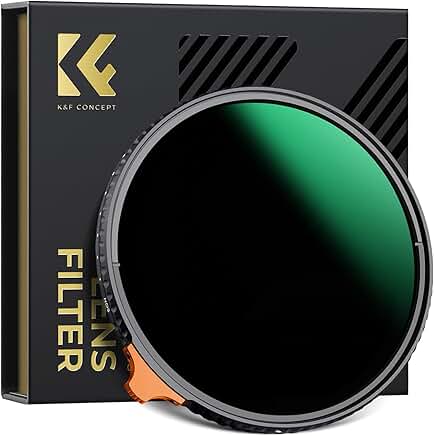
For those building a kit on a budget, K&F Concept has become a reliable name. In our review of budget camera lenses, we often emphasize that low price shouldn’t mean low quality, and the same applies to filters. The K&F Concept Kaleidoscope Filter utilizes K9 optical glass, which offers high light transmission and excellent refractive properties comparable to much more expensive options.
The effect here is aggressive. Unlike the subtle linear prism, the Kaleidoscope filter fractures the image into a central sharp spot surrounded by multiple repeated refractions. It is particularly effective for street photography where neon signs and city lights can be multiplied into a chaotic, cyberpunk aesthetic. We appreciated that K&F includes a decent rotating frame, though it feels slightly less dampened than the Prism Lens FX version.
One tip from our lab: be careful with your focal length. On a wide angle lens (wider than 35mm), you may see the dark edges of the filter ring (vignetting). We found the sweet spot to be around 50mm to 85mm, where the effect fills the frame beautifully without hard black corners.
3. Lensbaby Omni Creative Filter System
The Ultimate System for Controlled Optical Distortion

If you are serious about creative optics, the Lensbaby Omni System is not just a filter—it is a playground. Unlike standard screw-on filters that offer one specific look, the Omni system uses a magnetic ring that sits on your lens threads. You then magnetically attach various “wands” (crystals, prisms, and films) to the front of the lens. This allows for a level of customization that static filters cannot match.
During our testing, we found the Omni system to be superior for landscape photography where you might want to introduce a subtle flare or reflection in just the top corner of the sky without affecting the foreground. You can slide a triangular prism wand partially in front of the glass to catch a sun flare, or use a stretch glass wand to blur out distracting elements. It works exceptionally well with any interchangeable camera lens that has front filter threads.
The learning curve is steeper here. You need to learn how to position the wands relative to your aperture to get the desired softness. However, for professional portrait and wedding photographers, the ability to create unique, repeatable foreground bokeh makes the Omni system a powerful tool in the arsenal.
Why Use a Prism Filter?
In an era where every digital single lens reflex camera produces clinically perfect images, prism filters inject a sense of organic chaos. They work by bending light before it hits the sensor, creating effects that digital post-processing struggles to replicate authentically. The physics of refraction through real glass creates rainbows, flares, and depth cues that Photoshop filters often fail to mimic.
Choosing the Right Lens for Prisms
Not all lenses play well with prisms. Through our extensive testing, we have established a few rules of thumb:
- Focal Length Matters: We recommend using a lens with a focal length of at least 50mm. A macro lens can also be an interesting choice, allowing you to focus on the refractive element itself or the distorted subject at close range.
- Aperture is Key: To blend the prism effect smoothly with your image, shoot at wide apertures (f/1.8, f/2.0, or f/2.8). Small apertures (like f/11) will render the prism glass as a hard, distracting obstruction rather than a soft, dreamy blur.
- Filter Thread Size: Most high-end prism filters come in large sizes like 77mm or 82mm. We recommend buying the largest size and using step-up rings for your smaller lenses. This is a common strategy we advise in our guide to best camera lenses under $1000, ensuring your accessories outlast your current lens body.
Whether you are looking to upgrade your kit after reading our guide on the best first lens upgrade after a kit lens, or you are a seasoned pro looking for a spark of inspiration, a prism filter is a worthy addition to your bag.
Frequently Asked Questions
What is the best focal length to use with a prism lens filter?
We recommend using a focal length between 50mm and 85mm. Wider lenses (like 24mm) often see the edges of the filter ring (vignetting), while telephoto lenses help compress the scene and blend the refractive effect more smoothly.
Can I use a prism filter for video recording?
Absolutely. Prism filters are incredibly popular in music videos and creative filmmaking. The rotating mechanism on filters like the Prism Lens FX allow you to create dynamic, moving refractions while recording.
Do prism filters lower image quality?
Technically, yes, as you are placing additional glass elements in front of your lens. However, high-quality filters using K9 or BK7 optical glass minimize clarity loss. The goal is creative distortion, so a slight drop in clinical sharpness is usually the intended aesthetic.
What is the difference between a linear prism and a kaleidoscope filter?
A linear prism takes a section of the image and repeats it on one axis (e.g., creating a clone of the subject next to them). A kaleidoscope filter fractures the image into multiple triangular repetitions surrounding a center point, creating a much more chaotic, ‘fly-eye’ effect.
Do I need a special adapter for the Lensbaby Omni system?
The Lensbaby Omni system screws into your lens’s filter thread just like a standard filter. It comes with step-up and step-down rings to fit a variety of lens diameters (typically 49mm to 82mm), making it compatible with most standard interchangeable lenses.