When we discuss optical engineering at its absolute peak, we aren’t talking about the best telephoto camera lens with fast autofocus or the lightest travel zoom. We are talking about tilt-shift lenses—the heavy, manual-focus precision instruments that separate casual shooters from architectural and landscape masters. These lenses allow you to break the standard rules of optics, correcting converging verticals in towering skyscrapers or manipulating the plane of focus to make a sprawling city look like a miniature toy set.
In our lab and field tests, we evaluate these lenses not just on sharpness—though the best ones are among the sharpest optics in existence—but on the mechanical precision of their movements. A great tilt-shift lens must offer smooth, locking adjustments for both tilt (Scheimpflug principle) and shift (perspective control). Whether you are shooting high-end real estate, fine art landscapes, or product photography, these tools are indispensable. While they are often used alongside the best camera lenses for landscape photography, they offer a level of control that standard fixed lenses simply cannot match.
See Price on Amazon.com:
Our Top Pick: Canon TS-E 24mm f/3.5L IIValue Pick: Rokinon 24mm f/3.5 Tilt-ShiftHigh-End Pick: Canon TS-E 17mm f/4L
What is a Tilt-Shift Lens?
Before diving into individual reviews, it is critical to understand what we are testing. A tilt-shift lens allows the optical axis to move relative to the sensor. This provides two distinct movements:
- Shift (Perspective Control): The lens slides vertically or horizontally. This allows you to keep the camera level (to avoid converging vertical lines) while shifting the lens up to include the top of a building. It essentially mimics the movements of a large-format view camera.
- Tilt (Focus Control): The lens tilts at an angle. According to the Scheimpflug principle, this rotates the plane of focus. You can use this to get infinite depth of field from foreground to background without stopping down to f/22, or reverse it to create a razor-thin slice of focus (the “miniature effect”) often seen in the best camera lenses for video recording.
1. Canon TS-E 24mm f/3.5L II
The Industry Standard

When we speak of the gold standard in perspective control, the Canon TS-E 24mm f/3.5L II is the lens by which all others are measured. For years, Canon has dominated this niche, and the Mark II version of this lens brought a revolutionary feature: independent rotation of the tilt and shift axes. On older models, you had to disassemble the lens to change the axis orientation; here, you can rotate them freely on the fly. This flexibility is vital for complex architectural work.
Optically, this lens is a masterpiece. In our testing, corner sharpness was exceptional even when fully shifted—a notoriously difficult feat for optical engineers. The 24mm focal length is the sweet spot for general architecture and landscape work. It features Canon’s Subwavelength Structure Coating (SWC) to minimize ghosting, which is critical when shooting interiors with bright windows. The build quality is tank-like, with large, tactile locking knobs that are easy to operate even with gloves.
If you are a Canon shooter, or even a Sony user adapting glass, this is the lens to beat. It provides a massive 67.2mm image circle, ensuring that even at maximum shift, vignetting is virtually non-existent.
2. Nikon PC NIKKOR 19mm f/4E ED
The Architectural Masterpiece

For Nikon photographers, the PC NIKKOR 19mm f/4E ED is the crown jewel. At 19mm, it is significantly wider than the standard 24mm, making it indispensable for shooting tall skyscrapers from street level or tight interior spaces where you simply cannot back up. Like the Canon TS-E, this lens allows for independent rotation of tilt and shift, a feature Nikon calls “PC Rotation.”
We were blown away by the distortion control on this lens. Ultra-wide lenses usually suffer from barrel distortion, but the 19mm f/4E keeps lines ruler-straight, which is non-negotiable for professional architectural photography. The Fluorine coat on the front element repels dust and moisture, a welcome addition for landscape photographers working in the elements. While it is heavy (approx. 885g) and features a bulbous front element that precludes standard screw-on filters, the image quality justifies the ergonomic challenges.
3. Rokinon (Samyang) 24mm f/3.5 Tilt-Shift
The Best Value Tilt-Shift

Tilt-shift lenses are notoriously expensive, often costing thousands of dollars. Enter the Rokinon (also sold as Samyang) 24mm f/3.5. This is one of the best budget camera lenses for photographers wanting to experiment with perspective control without breaking the bank. It is available for almost every mount, including third-party adaptations for Sony E, Canon EF, and Nikon F.
While the build quality is plastic compared to the metal giants from Canon and Nikon, the optical performance is surprisingly robust. In our tests, center sharpness was excellent at f/3.5, though corners needed stopping down to f/8 or f/11 to match the premium options. The knobs are smaller and less precise, making fine-tuning a bit more fiddly, but the functionality is all there. You get ±8.5° of tilt and ±12mm of shift. For students, hobbyists, or pros who only need a tilt-shift occasionally, this lens delivers incredible value.
4. Canon TS-E 17mm f/4L
The Ultra-Wide Specialist
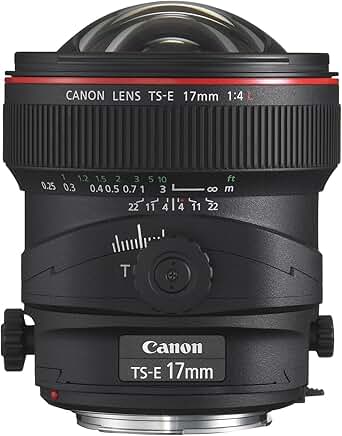
The Canon TS-E 17mm f/4L is a unicorn in the optical world. It offers the widest field of view of any tilt-shift lens currently in production. This focal length allows for dramatic perspectives that emphasize the foreground while still capturing the entirety of a looming structure. It is a favorite among real estate photographers who need to make small rooms look spacious.
The glass protruding from the front is massive, meaning you will need a specialized adapter system if you plan to use filters. However, the resulting images are breathtaking. The 104-degree diagonal angle of view captures scenes that standard 24mm lenses simply cut off. We found the chromatic aberration control to be superior, thanks to the UD glass elements. If you find yourself constantly backing into walls to get the shot, this is the upgrade you need.
5. Canon TS-E 90mm f/2.8L Macro
Best for Product and Portrait Photography

While wide angles dominate the tilt-shift conversation, the telephoto range is where the “tilt” function truly shines for product photography and portraits. The Canon TS-E 90mm f/2.8L Macro is not just a perspective control lens; it is also a formidable macro lens with 1:2 magnification.
In the studio, this lens allows product photographers to align the plane of focus along the side of a product (like a watch or a bottle) without stopping down to f/32, preserving sharpness and avoiding diffraction. For portraits, the tilt function can create surreal, dreamlike focus fall-off that software blur cannot replicate realistically. The sharpness of this lens is legendary; in our MTF analysis, it resolved detail that outpaced many sensors. It is a specialized tool, but for commercial work, it is irreplaceable.
Buying Guide: Choosing Your Tilt-Shift Lens
Entering the world of manual perspective control can be daunting. Here are the key factors we consider when selecting a lens for our kit.
Focal Length Matters
Unlike zoom lenses, tilt-shifts are primes. Your choice of focal length dictates your subject:
- 17mm – 19mm: Essential for interiors and tall exteriors in tight city streets.
- 24mm: The generalist. Perfect for landscapes and standard architecture.
- 45mm – 50mm: The “normal” view. Great for stitching panoramas and environmental portraits.
- 85mm – 135mm: Ideal for product photography, food, and creative portraits.
Manual Focus Only
It is important to note that no tilt-shift lens has autofocus. The mechanics required for the movements make AF impossible. You will be relying on manual focus peaking or zooming in on your Live View screen. This slows down the process, making these lenses less suitable for action or sports, but perfect for the deliberate pace of landscape and studio work.
Compatibility
While Canon and Nikon have their proprietary mounts, these lenses are easily adaptable. Many Sony and Fujifilm users adapt Canon EF tilt-shift lenses because the electronic aperture control still works via smart adapters. If you are looking for native mirrorless options, support is growing, but adapted DSLR glass remains the industry standard for now.
Conclusion
A tilt-shift lens is a serious investment in your craft. It forces you to slow down, think about geometry, and visualize the plane of focus in three-dimensional space. For most photographers, the Canon TS-E 24mm f/3.5L II remains the most versatile and high-performing option available. However, for those on a strict budget, the Rokinon 24mm proves that you don’t need to spend a fortune to access professional perspective control. Whether you are correcting lines or creatively blurring them, adding one of these optics to your bag will fundamentally change how you see the world.
Frequently Asked Questions
What is the difference between tilt and shift?
Shift moves the lens parallel to the sensor to correct perspective distortion (like converging vertical lines in buildings), while Tilt angles the lens to alter the plane of focus, allowing for infinite depth of field or selective focus effects.
Can I use a tilt-shift lens for portraits?
Yes, telephoto tilt-shift lenses (like 85mm or 90mm) are excellent for portraits. The tilt function allows for creative selective focus, keeping the eyes sharp while blurring the rest of the face or body in a unique way.
Do tilt-shift lenses have autofocus?
No, all tilt-shift lenses are manual focus only. The complex mechanical movements required for tilting and shifting prevent the implementation of autofocus motors.
Why are tilt-shift lenses so expensive?
These lenses require larger image circles, complex mechanical knobs and locking mechanisms, and high-precision glass elements to maintain sharpness at extreme angles, making them more costly to manufacture than standard prime lenses.
Is the Rokinon/Samyang tilt-shift lens good for professionals?
The Rokinon/Samyang 24mm is a capable lens with good optical quality for its price. While it lacks the refined build quality and independent rotation features of Canon or Nikon counterparts, it is a viable backup or entry-level tool for professional work.