The debate between prime and zoom lenses is perhaps the most enduring argument in photography circles. At CameraLensReviews, we view this not just as a choice of convenience, but as a fundamental decision about how you render light and interact with your subject. When we test lenses in our lab, measuring lines of resolution per millimeter and scrutinizing corner sharpness, we see distinct optical signatures that define these two categories. Whether you are building a kit for Canon, Nikon, or Sony systems, understanding the physical and optical trade-offs is essential. In this comprehensive guide we Prime vs Zoom Lenses – and Which Should You Buy.
See Price on Amazon.com:
Our Top Pick: Sigma 24-70mm f/2.8 DG DN ArtValue Pick: Canon EF 50mm f/1.8 STMHigh-End Pick: Sony FE 70-200mm f/2.8 GM OSS II
The Core Distinction: Fixed vs. Variable Focal Length
Before diving into the complex MTF charts, let’s establish the baseline. As detailed in our Camera Lenses Explained: A Complete Buyer’s Guide, a prime lens has a fixed focal length (e.g., 35mm, 50mm, 85mm). To change your framing, you must physically move. A zoom lens allows you to vary the focal length (e.g., 24-70mm) by rotating a ring or pushing a barrel, altering the magnification without changing your position.
While this sounds like a simple trade-off between convenience and constraint, the implications for optical engineering are profound.
Prime Lenses: The Pursuit of Optical Perfection
When we test prime lenses, we often find superior light transmission and edge-to-edge sharpness compared to zooms at similar price points. Because the optical formula is optimized for a single focal length, engineers can correct aberrations—such as chromatic aberration and barrel distortion—more effectively.
The “Fast Glass” Advantage
The most significant advantage of prime lenses is the maximum aperture. Common primes feature apertures of f/1.8, f/1.4, or even f/1.2. This allows for:
- Superior Low Light Performance: More light hitting the sensor means lower ISOs and cleaner images.
- Depth of Field Control: That creamy, melted background (bokeh) is far easier to achieve at f/1.4 than at f/2.8 or f/4.
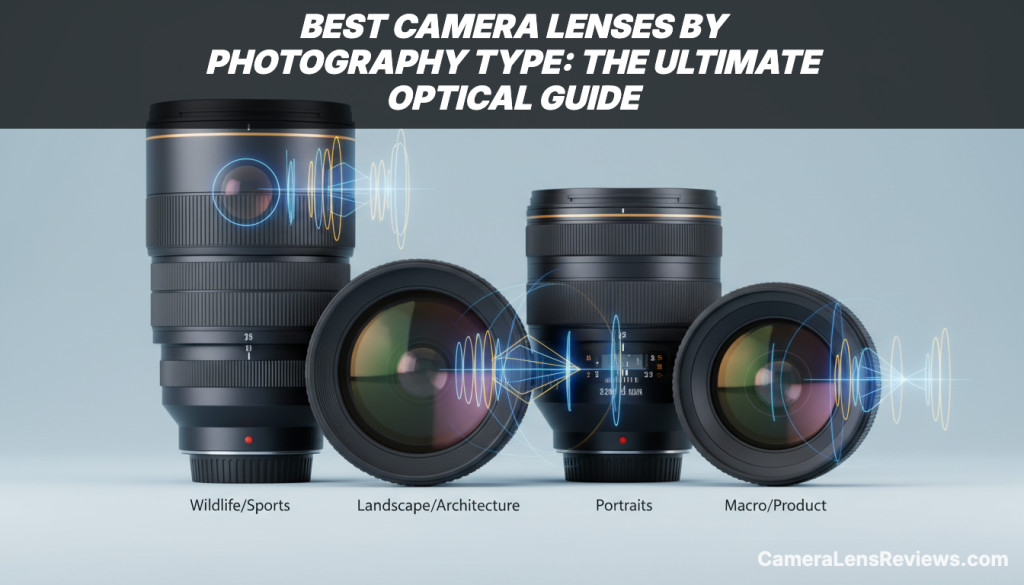
For photographers heavily invested in portraiture, as noted in our analysis of Best Camera Lenses by Photography Type, the isolation provided by a fast prime is often non-negotiable.
Example: Sony FE 50mm f/1.2 GM
This lens represents the pinnacle of prime engineering. In our hands, the focus ring provides precise tactile feedback, and the resolving power at f/1.2 is nothing short of clinical. It is heavy, expensive, and inflexible in focal length, but the image quality is unmatched.
Zoom Lenses: Versatility and Modern Engineering
Historically, zoom lenses were considered optically inferior. However, modern computer-aided design has closed the gap significantly. High-end zooms, particularly the “Holy Trinity” (16-35mm, 24-70mm, 70-200mm), are now staples for professionals using Fujifilm and other mirrorless systems.
The Workflow Benefit
The primary argument for a zoom lens is workflow speed. In event photography, weddings, or photojournalism, you cannot always “zoom with your feet.” A split-second change from a wide group shot to a tight portrait is only possible with a zoom. Furthermore, changing lenses in the field exposes your sensor to dust and moisture—a risk minimized by keeping a single versatile zoom mounted.
The Trade-offs
To achieve variable focal lengths, zooms require complex internal movements and more glass elements. This often results in:
- Slower Apertures: Most pro zooms max out at f/2.8. Consumer zooms often have variable apertures (e.g., f/3.5-5.6), which struggle in low light.
- Size and Weight: A 24-70mm f/2.8 is significantly heavier than a 35mm f/1.8.
- Distortion: Zooms are more prone to pincushion or barrel distortion, though modern in-camera corrections handle this well.
Example: Sigma 24-70mm f/2.8 DG DN Art
We frequently recommend the Sigma 24-70mm as a top-tier alternative to native glass. It offers the classic standard zoom range with an f/2.8 aperture, balancing professional sharpness with a price point that undercuts first-party options. It covers 90% of the focal lengths a generalist photographer needs.
Third-Party Options: Bridging the Gap
The market has seen a surge in high-quality third-party lenses from manufacturers like Tamron and Sigma. These brands often offer unique zoom ranges (like 35-150mm f/2-2.8) that attempt to bridge the gap between the speed of a prime and the flexibility of a zoom.
Conclusion: Which belongs in your bag?
Ultimately, the choice depends on your specific photographic discipline. If you demand the absolute highest resolution, minimal distortion, and the ability to shoot in near-darkness, a prime lens is the superior optical tool. For street photography and portraits, the constraints of a prime often fuel creativity.
However, for landscapes, events, and travel where carrying a bag of heavy glass is impractical, a high-quality zoom is indispensable. Most professionals we work with eventually own both: a reliable f/2.8 zoom for the heavy lifting, and a fast f/1.4 prime for when the light drops and the magic happens.
Frequently Asked Questions
Do prime lenses always have better image quality than zoom lenses?
Generally, yes. Prime lenses have fewer glass elements and are optimized for a single focal length, leading to better sharpness and less distortion. However, modern high-end ‘pro’ zoom lenses have closed this gap significantly.
Why are prime lenses better for low light photography?
Prime lenses can be manufactured with much wider maximum apertures (like f/1.4 or f/1.8) compared to zooms (which usually max out at f/2.8). This allows significantly more light to reach the sensor.
What is the ‘Holy Trinity’ of zoom lenses?
The Holy Trinity refers to a set of three f/2.8 zoom lenses that cover all essential focal lengths: a wide-angle (14-24mm or 16-35mm), a standard zoom (24-70mm), and a telephoto zoom (70-200mm).
Is a prime lens good for beginners?
Yes. A ‘Nifty Fifty’ (50mm f/1.8) is often recommended for beginners because it is affordable, teaches the photographer to move to compose (zooming with your feet), and provides professional-looking background blur.
Do zoom lenses have variable aperture?
Consumer-grade zoom lenses often have variable apertures (e.g., f/3.5-5.6), meaning the aperture gets smaller as you zoom in. Professional zoom lenses usually feature a constant aperture (e.g., f/2.8) throughout the entire zoom range.