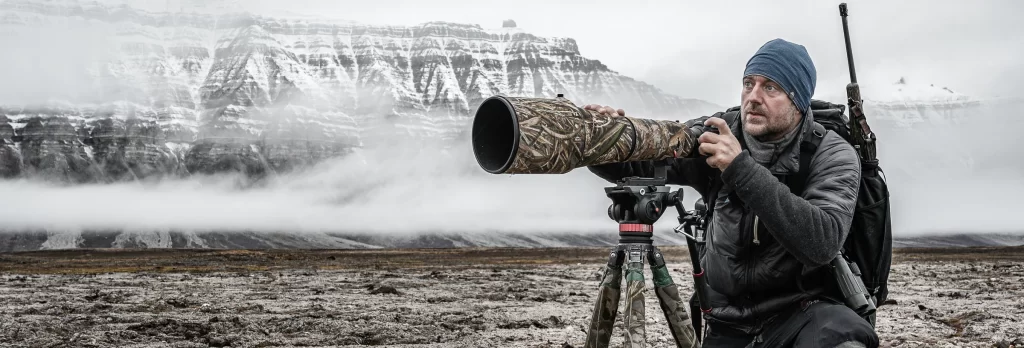
When we analyze the work of Danish wildlife photographer Morten Hilmer, we aren’t just looking at pictures of animals; we are witnessing the raw, silent power of the Arctic. Unlike photographers who chase golden hour in comfortable safaris, Hilmer is known for lying in the snow for hours at -30°C, waiting for a musk ox or an arctic fox to emerge from the blizzard. Capturing these moments requires more than just patience; it demands optical engineering that can survive conditions where lesser gear freezes and fails.
For years, our team at CameraLensReviews has followed Hilmer’s transition from DSLR to Mirrorless, and his current setup represents the pinnacle of optical technology for harsh environments. His primary weapon of choice is not just a lens—it is a weather-sealed fortress that allows him to change focal lengths without ever exposing his sensor to the biting wind and snow. If you want to replicate that signature “silence of the north” look, understanding his gear choices is the first step.
See Price on Amazon.com:
Our Top Pick: Nikon Z 600mm f/4 TC VR SValue Pick: Nikon Z 180-600mm VRHigh-End Pick: Nikon Z 400mm f/2.8 TC VR S
The Arctic King: Nikon NIKKOR Z 600mm f/4 TC VR S
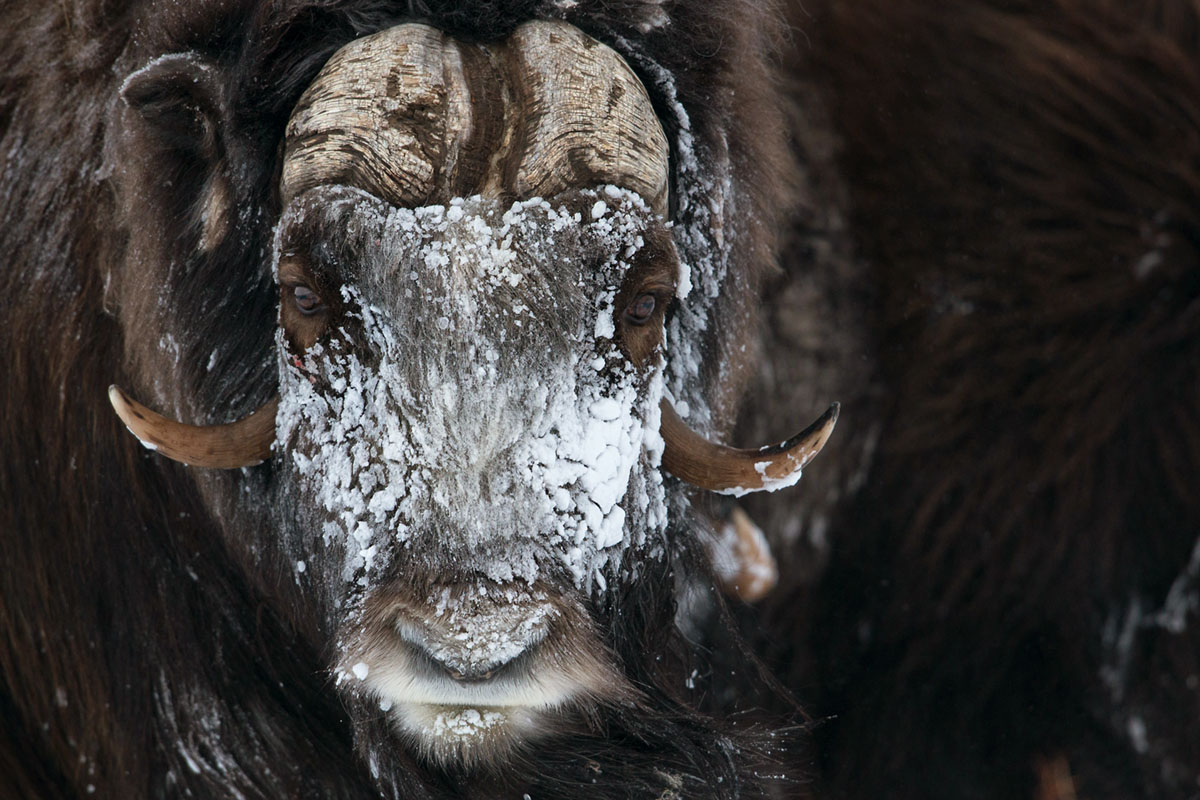
If there is one lens that defines Morten Hilmer’s current workflow, it is the Nikon NIKKOR Z 600mm f/4 TC VR S. When we tested this lens, we immediately understood why it appeals to a photographer who spends weeks in the tundra. The headline feature is the built-in 1.4x teleconverter.
In the field, changing a teleconverter usually means detaching the lens, exposing the camera sensor and rear element to snow, dust, and moisture. In Hilmer’s world, that split second of exposure can ruin a shoot. With this lens, a simple flick of a switch on the barrel transforms it from a bright 600mm f/4 into an 840mm f/5.6. This versatility allows him to capture environmental portraits at 600mm and tight headshots at 840mm without ever moving his position or risking his gear.
Optically, this lens is flawless. The sharpness at f/4 is staggering, resolving every snowflake on a musk ox’s coat. The vibration reduction (VR) is critical for Hilmer, who often handholds this lens despite its size—a feat made possible by its surprisingly balanced weight distribution compared to older F-mount super-telephotos.
See Price on Amazon – Nikon Z 600mm f/4 TC VR S >>
The Low-Light Specialist: Nikon NIKKOR Z 400mm f/2.8 TC VR S
Before the 600mm became his primary, and still for specific low-light assignments, Hilmer utilizes the Nikon NIKKOR Z 400mm f/2.8 TC VR S. While it lacks the extreme reach of the 600mm, the f/2.8 aperture gathers twice as much light. This is crucial during the “blue hour” in the Arctic, where the sun may not rise above the horizon for weeks.
Much like how Paul Nicklen achieves his underwater wildlife look, Hilmer uses the f/2.8 aperture to create a dreamy, shallow depth of field that separates the subject from the chaotic, snowy background. This lens also features the built-in teleconverter, turning it into a 560mm f/4 instantly. For photographers prioritizing low-light performance over maximum reach, this is the superior choice.
See Price on Amazon – Nikon Z 400mm f/2.8 TC VR S >>
The Accessible Option: Nikon NIKKOR Z 180-600mm f/5.6-6.3 VR
Not everyone can afford a lens that costs as much as a car. Morten Hilmer is very open about his past use of budget-friendly gear, specifically the Tamron 150-600mm G2 and the Nikon 200-500mm f/5.6. He proved that you don’t need flagship glass to tell a compelling story.
For modern Z-mount shooters looking to emulate his style on a budget, the Nikon NIKKOR Z 180-600mm f/5.6-6.3 VR is the spiritual successor to those lenses. While it lacks the f/4 aperture, its internal zoom mechanism (a rare feature in this price class) ensures that the lens barrel doesn’t extend, making it much more weather-resistant than its telescoping competitors. We find this lens to be the perfect balance of portability and reach for hiking photographers who cannot rely on a sherpa or a sled.
If you are shooting in extreme adventure scenarios, similar to the conditions discussed in our Jimmy Chin lens guide, the internal zoom of the 180-600mm prevents dust and moisture pump-action, significantly extending the lens’s lifespan.
See Price on Amazon – Nikon Z 180-600mm VR >>
Why Gear Matters in the Arctic
Morten Hilmer’s photography is defined by the elements. When temperatures drop below -20°C, mechanical shutters can freeze, and battery life plummets. His switch to the Nikon Z9 mirrorless body was driven by the complete removal of the mechanical shutter, eliminating a major failure point. Combined with the Z-mount lenses mentioned above, he creates a sealed system.
He also employs unique field techniques, such as using a custom-built sled to drag his heavy 600mm lens across the snow, allowing him to shoot from a low angle without fatigue. This “eye-level” perspective is a hallmark of his style, creating an intimate connection with the animal. For those using other systems, checking our Sony or Canon categories can help find equivalent super-telephotos with similar weather sealing capabilities.
Conclusion
To shoot like Morten Hilmer, you need gear that disappears. The Nikon Z 600mm f/4 TC VR S is his ultimate tool because it simplifies the complex logistics of arctic photography into a single switch. It removes the friction between seeing the moment and capturing it.
However, the gear is only half the equation. Whether you choose the flagship prime or the versatile 180-600mm zoom, the key takeaway from Hilmer’s work is resilience—both for the photographer and the glass. For more insights on achieving specific photographic styles, explore our guides on Chris Burkard’s landscape choices or Eric Kim’s street photography setup.
Frequently Asked Questions
What is the main lens Morten Hilmer uses for wildlife?
Morten Hilmer’s primary lens for harsh conditions is the Nikon NIKKOR Z 600mm f/4 TC VR S. He favors it for its built-in 1.4x teleconverter, which allows him to switch to 840mm instantly without exposing the sensor to snow or rain.
Does Morten Hilmer use a tripod?
Yes, for long stakeouts he uses a tripod (often a Sachtler Flowtech with a video head), but he frequently handholds the Nikon Z 600mm f/4 TC VR S for short periods due to its excellent balance and weight distribution.
What camera body does Morten Hilmer use?
Morten primarily uses the Nikon Z9. Its lack of a mechanical shutter makes it incredibly durable in freezing temperatures, and its battery life and autofocus performance are essential for his arctic expeditions.
What is a budget alternative to Morten Hilmer’s gear?
Morten previously used the Tamron 150-600mm G2 and Nikon 200-500mm f/5.6. Today, the Nikon Z 180-600mm f/5.6-6.3 VR is the best budget-friendly alternative for Z-mount users wanting similar reach and versatility.
Why does Morten Hilmer prefer lenses with built-in teleconverters?
In harsh arctic conditions, changing a lens or attaching an external teleconverter exposes the camera’s internal components to moisture and freezing cold. A built-in teleconverter allows him to change focal length safely and instantly.