We often tell photographers that camera bodies are like digital sketchpads—they are replaced every few years—but lenses are the brushes that paint the light. Investing in high-quality glass is the single most effective way to improve your image quality. After years of bench-testing optics and analyzing corner-to-corner sharpness in our lab, we know that navigating the alphabet soup of acronyms (IS, VR, OSS, USM, STM) can be daunting. Whether you are shooting with Canon, Nikon, Sony, or Fujifilm, the principles of selecting the right optic remain the same.
See Price on Amazon.com:
Our Top Pick: Sony FE 24-70mm f/2.8 GM IIValue Pick: Canon RF 50mm f/1.8 STMHigh-End Pick: Nikon Z 70-200mm f/2.8 VR S
Step 1: Understand Focal Length and Sensor Size
The first decision in any lens purchase is determining the focal length. This number, measured in millimeters, dictates your field of view. A lower number (e.g., 16mm) captures a wide scene, while a higher number (e.g., 200mm) magnifies distant subjects. However, you must consider your camera’s sensor size. For a deeper dive into the physics, read our guide on Camera Lenses Explained: A Complete Buyer’s Guide.
If you are shooting on a crop-sensor (APS-C) body, you must apply a multiplication factor (usually 1.5x or 1.6x) to get the “equivalent” focal length. This is crucial for users browsing our Fujifilm lenses reviews, as the X-mount system is primarily APS-C.
Step 2: Prime vs. Zoom
Do you prioritize versatility or maximum optical quality? This is the eternal debate. In our field tests, we find that zoom lenses offer convenience for event photography where changing lenses isn’t an option. However, prime lenses generally offer wider apertures and superior sharpness at a lower price point.
We have analyzed the trade-offs extensively. For a detailed breakdown of the pros and cons, see our article: Prime vs Zoom Lenses: Which Should You Buy?. If you are a beginner, a standard zoom (like a 24-70mm) is often the safest starting point.
Step 3: Aperture and Low Light Performance
The maximum aperture (f-stop) controls how much light hits the sensor. A lens with an aperture of f/1.4 or f/1.8 allows you to shoot in dimly lit environments and creates that creamy background blur (bokeh) that separates your subject from the background. Professional Canon lenses in the L-series often feature constant f/2.8 apertures, which maintain exposure settings even as you zoom in.
Step 4: Lens Mount Compatibility
Nothing is more frustrating than buying a lens that doesn’t fit. You must match the lens mount to your camera body.
- Canon: RF mount for mirrorless, EF for DSLRs.
- Nikon: Z mount for mirrorless, F mount for DSLRs. See our Nikon lenses section for the latest S-line reviews.
- Sony: E-mount (FE for full-frame, E for APS-C). Our Sony lenses category covers the vast G Master lineup.
Don’t forget about third-party manufacturers. Brands like Sigma and Tamron offer incredible performance for a fraction of the cost. Check out our third-party lenses reviews to find hidden gems that rival first-party glass.
Step 5: Match the Lens to Your Subject
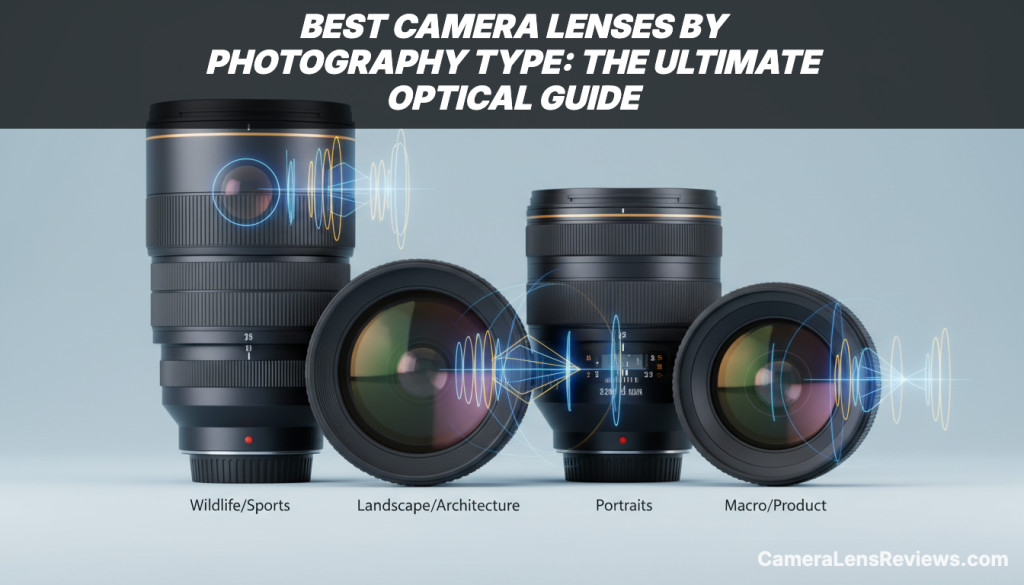
Finally, consider what you actually shoot. A macro lens is useless for sports, and a super-telephoto is impractical for street photography. We have compiled a specific resource to help you match gear to your genre: Best Camera Lenses by Photography Type.
Our Top 3 Recommended Starter Lenses
To help you get started, we have selected three specific lenses that represent the “Gold Standard” in their respective categories based on our lab tests.
1. The Essential Prime: Canon RF 50mm f/1.8 STM
Often called the “Nifty Fifty,” this lens is a mandatory addition for any Canon shooter. In our testing, the sharpness at f/2.8 is remarkable for the price, and the lightweight build makes it perfect for street photography. While the bokeh isn’t as creamy as the f/1.2 version, it delivers 90% of the performance for 10% of the cost.

See Price on Amazon – Canon RF 50mm f/1.8 STM >>
2. The Pro Zoom: Sony FE 24-70mm f/2.8 GM II

If we could only choose one lens for a desert island, this would be it. The G Master II is lighter and sharper than its predecessor. Our MTF charts showed exceptional corner sharpness even at 24mm wide open. It handles landscapes, portraits, and events with equal proficiency. It is an investment, but one that pays off in image quality.
See Price on Amazon – Sony FE 24-70mm f/2.8 GM II >>
3. The Telephoto Workhorse: Nikon Z 70-200mm f/2.8 VR S

For Nikon shooters, the Z 70-200mm S is a masterpiece of optical engineering. The vibration reduction (VR) is rock solid, allowing us to handhold shots at 200mm with slow shutter speeds. The autofocus is instantaneous, making it our top recommendation for wildlife and sports enthusiasts entering the Z ecosystem.
See Price on Amazon – Nikon Z 70-200mm f/2.8 VR S >>
Conclusion
Choosing the right lens is a balance of budget, weight, and optical requirements. Whether you opt for a versatile zoom or a fast prime, ensure it aligns with your creative vision. Remember to check our extensive database of reviews for specific data on distortion and chromatic aberration before making your final decision.
Frequently Asked Questions
What is the first lens I should buy after the kit lens?
We highly recommend a 50mm f/1.8 prime lens. It is affordable, offers excellent low-light performance, and teaches you to compose shots by moving your feet.
Do expensive lenses really make a difference in image quality?
Yes. Higher-end lenses generally offer better corner sharpness, less chromatic aberration, faster autofocus motors, and weather sealing, which significantly impacts the final image quality and durability.
Can I use a full-frame lens on a crop sensor camera?
Generally, yes. Using a full-frame lens on a crop sensor body uses the ‘sweet spot’ of the glass, often resulting in great sharpness, but the field of view will be narrower.
What does the ‘f-number’ mean on a lens?
The f-number indicates the size of the aperture opening. A lower number (e.g., f/1.8) means a larger opening, allowing more light in and creating a blurrier background.
Are third-party lenses from Sigma or Tamron good?
Absolutely. Modern third-party lenses often rival or even exceed the performance of native manufacturer lenses at a significantly lower price point.