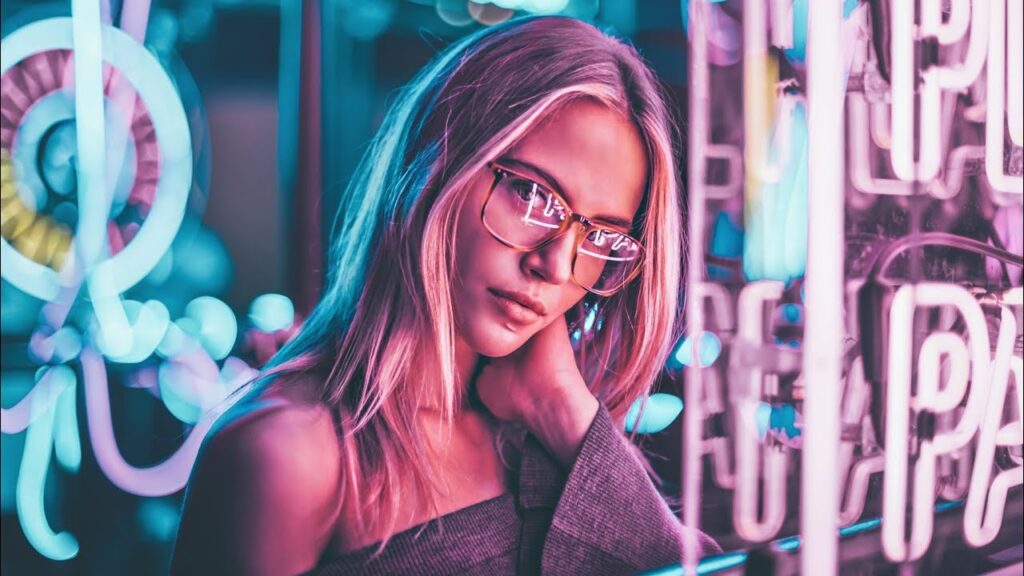
If you have spent any time on Instagram in the last five years, you have undoubtedly seen the “Woelfel Look.” Brandon Woelfel transformed modern digital portraiture with his signature blend of cotton-candy colors, neon signs, oversized glasses, and—most importantly—dreamy, impossible-to-ignore bokeh. While his editing style plays a huge role, the optical foundation of his work relies heavily on specific focal lengths and extremely fast apertures. When we analyzed his gear history, from the Nikon D750 to the Z7 II, one thing became clear: this look is built on prime lenses.
For photographers aiming to recreate that whimsical, depth-filled aesthetic, the kit lens simply won’t cut it. Woelfel’s style demands glass that can obliterate a background while keeping a subject’s eyelashes razor-sharp. We have broken down the specific focal lengths that define his portfolio, focusing on the 50mm-58mm sweet spot that serves as his workhorse, as well as the 35mm he uses for environmental context. Whether you shoot Nikon, Sony, or Canon, mastering this look starts with the right focal length.
See Price on Amazon.com:
Our Top Pick: Nikon Z 50mm f/1.2 SValue Pick: Sigma 35mm f/1.4 DG DN ArtHigh-End Pick: Sony FE 50mm f/1.2 GM
The “Magic” Range: 50mm to 58mm
If you had to pick a single focal length to define Brandon Woelfel’s career, it would be the 58mm. For years, his weapon of choice was the legendary Nikon AF-S NIKKOR 58mm f/1.4G. This lens is famous not for its chart-topping sharpness, but for its “three-dimensional” rendering and smooth bokeh transition. In the mirrorless age, however, the 50mm f/1.2 has taken the torch.
This focal range is crucial because it mimics the human eye but with a cinematic twist. Unlike wider lenses that distort facial features close up, a 50mm or 58mm allows you to get close enough to fill the frame with a subject holding a prism or fairy lights, without the nose appearing bulbous. This balance is similar to how documentary photographers operate, though the intent is different. For example, while you might read how to recreate the documentary style of Steve McCurry using similar focal lengths, Woelfel uses the 50mm to create fantasy rather than reality.
Nikon Z 50mm f/1.2 S
For modern Nikon shooters wanting to emulate Woelfel’s Z7 II workflow, the Nikon Z 50mm f/1.2 S is the new gold standard. When we tested this lens, the first thing we noticed was the absolute obliteration of the background at f/1.2. Woelfel often shoots wide open to turn city lights into massive, soft orbs of color. This lens achieves that “cat-eye” bokeh effect near the corners that gives his images a swirling, magical quality.
The build quality is substantial—it is a heavy lens, but that weight translates to optical perfection. Unlike the older F-mount 58mm, which was soft wide open, the Z 50mm f/1.2 S is tack sharp from the center to the edges, allowing you to place your subject’s eye off-center without losing detail. It is the ultimate tool for that neon-lit, shallow-depth-of-field portraiture.
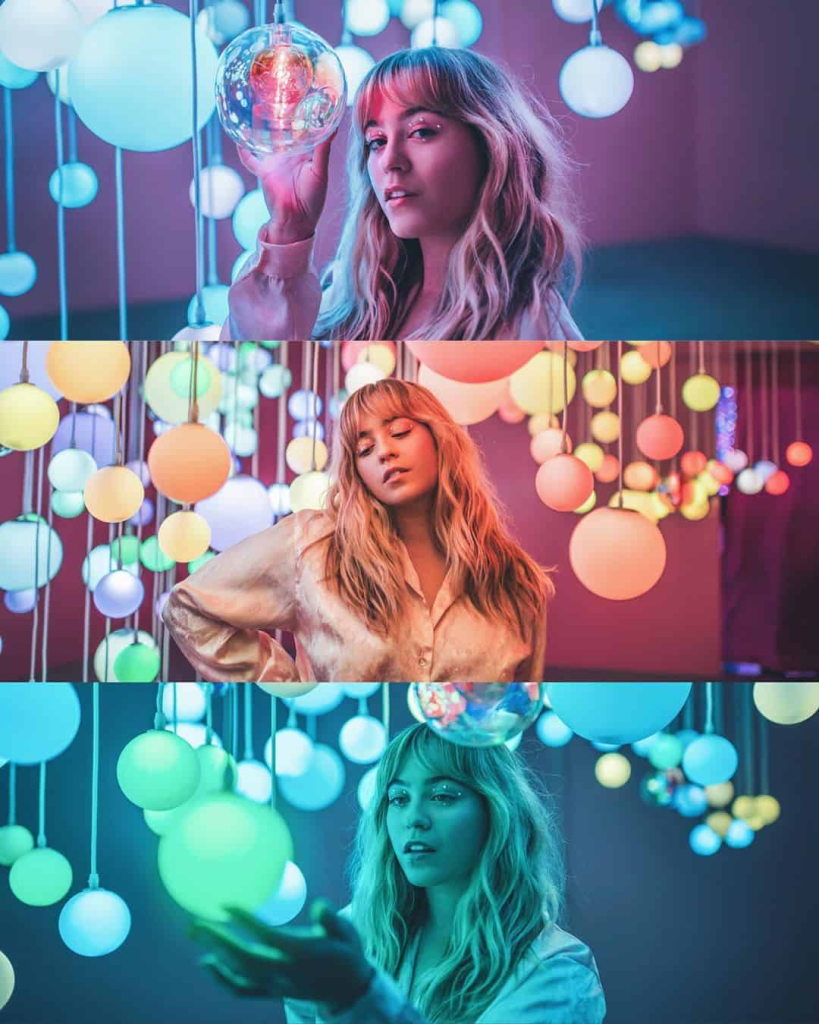
For those exploring other options within the Nikon ecosystem, check out our full Nikon lens reviews.
The Environmental Portrait: 35mm
While the 50mm/58mm creates intimate isolation, Brandon Woelfel frequently relies on a 35mm f/1.4 for shots that require more context. You will often see this focal length used in his “vlog-style” behind-the-scenes shots or when he incorporates large props like umbrellas, windows, or entire neon storefronts.
The 35mm focal length is versatile but tricky. It requires you to be mindful of your distance to the subject to avoid distortion. Interestingly, this is the same focal length favored by many street photographers for its storytelling ability. If you are interested in how this focal length applies to gritty street work, take a look at what prime lens helps recreate the style of Eric Kim. For Woelfel, however, the 35mm is less about grit and more about including the atmosphere—the smoke, the lights, and the location.
Sigma 35mm f/1.4 DG DN Art
The Sigma 35mm f/1.4 DG DN Art is our top recommendation for achieving this look without breaking the bank. Sigma’s “Art” series is renowned for its contrast and color rendering, which pairs perfectly with the vibrant post-processing style Woelfel is known for. In our field tests, the Sigma delivered punchy contrast straight out of camera, which helps when you are shooting in flat, low-light conditions before adding your own color grading.
It is sharp, fast, and handles flare exceptionally well—a critical feature when you are intentionally pointing your lens at neon signs and LED wands. You can find more details on compatible mounts in our Sigma lens category.
The Bokeh Beast: 85mm and Beyond
Occasionally, Woelfel steps back to an 85mm or even a 105mm f/1.4. These telephoto focal lengths offer extreme compression, making background lights appear massive relative to the subject. This is the “cinematic” look taken to the extreme.
This compression effect is similar to the techniques used in high-end video production. In fact, if you are looking to understand how lens choice influences cinematic depth, our guide on how to get the cinematic look of Peter McKinnon explores similar telephoto principles. For Woelfel, the 85mm is used when the background is messy or distracting; the tight field of view cuts out the clutter and turns a chaotic street into a smooth wash of color.
Sony FE 50mm f/1.2 GM
We are including the Sony FE 50mm f/1.2 GM here as the high-end alternative for non-Nikon shooters. If you are on the Sony E-mount system, this is the lens that gets you closest to the “Woelfel” 58mm vibe. It renders bokeh with a creaminess that rivals the legendary Nikon glass. During our review, we found the autofocus to be instantaneous, which is vital when working with moving props like sparklers or smoke bombs. It is a masterpiece of optical engineering.
For more options for your Alpha camera, browse our Sony lens reviews.
Conclusion
To truly capture the portrait style of Brandon Woelfel, you need more than just a camera; you need a fast prime lens that can manipulate light and depth. While he utilizes a 35mm for wider context and an 85mm/105mm for compression, the heart of his style lies in the 50mm to 58mm range with an aperture of f/1.4 or f/1.2. This specific combination allows for the intimacy and magical background separation that has defined his brand. Whether you choose the razor-sharp Nikon Z 50mm f/1.2 S or the character-rich Sigma Art series, shooting wide open is the first step toward that neon-soaked masterpiece.
Frequently Asked Questions
What specific lens made Brandon Woelfel famous?
Brandon Woelfel is most famously associated with the Nikon AF-S NIKKOR 58mm f/1.4G. He used this lens extensively on his Nikon D750 and D850 to create his signature look featuring creamy bokeh and excellent low-light performance.
Does Brandon Woelfel use 35mm or 50mm more?
While he uses both, the 35mm f/1.4 is often his ‘everyday’ lens for environmental portraits and vlogging, whereas the 50mm (or 58mm) is his go-to for tighter, more magical portraits with heavier background blur.
Why does Brandon Woelfel shoot at f/1.4?
Shooting at f/1.4 (or f/1.2) creates a very shallow depth of field. This blurs out distracting backgrounds, turning city lights into large bokeh balls, and isolates the subject, which is central to his whimsical, ethereal style.
Can I get the Brandon Woelfel look with a kit lens?
It is very difficult to replicate his look with a standard kit lens because they typically have narrow apertures like f/3.5-5.6. You need a ‘fast’ prime lens with an aperture of at least f/1.8, though f/1.4 is ideal for that extreme bokeh.
What camera does Brandon Woelfel use in 2024?
Brandon Woelfel has transitioned to Nikon’s mirrorless system, primarily using the Nikon Z7 II and Z8, often adapting his older F-mount glass or using the newer Z-mount S-line prime lenses.