If you’re looking to buy a portrait lens and want maximum background blur, sharp skin tones, and flattering compression, this guide breaks down the best portrait lenses you can buy right now — across Canon, Sony, Nikon, and Fujifilm systems.
See Price on Amazon.com:
Our Top Pick: Sony FE 85mm f/1.4 GMValue Pick: Sigma 85mm f/1.4 DG DN ArtHigh-End Pick: Canon RF 85mm f/1.2 L USM
There is a visceral reaction when you look through a truly exceptional portrait lens for the first time. The subject doesn’t just appear in the viewfinder; they seem to float, separated from the background by a curtain of beautifully rendered blur. At CameraLensReviews, we believe that portraiture is the ultimate test of optical engineering. It requires a delicate balance that purely technical charts often miss: the intersection of clinical sharpness on the eyelash and the gentle, flattering rolloff of skin tones.
When we tested the latest gear in our lab and out on location, we weren’t just looking for high MTF scores. We looked for character. We examined how these lenses handle backlight, how they render out-of-focus highlights (bokeh balls), and the tactile experience of the focus ring during a shoot. Whether you shoot with Canon lenses, Nikon lenses, or Sony lenses, the goal remains the same: isolating the subject to tell a story.
The Anatomy of a Perfect Portrait Lens
Before diving into specific models, it is crucial to understand the physics behind the glass. As we detailed in our guide on Camera Lenses Explained, focal length and aperture are the primary drivers of the “portrait look.” Typically, a focal length between 85mm and 135mm is ideal because it compresses facial features slightly, flattering the subject, whereas wide angles can distort noses and chins.
Furthermore, the debate between Prime vs Zoom Lenses is rarely as heated as it is in portrait photography. While a 70-200mm f/2.8 zoom is a versatile workhorse, our testing consistently shows that prime lenses (fixed focal length) offer superior light transmission (often f/1.4 or f/1.2) and smoother background blur, which is essential for professional subject separation.
How We Tested Portrait Lenses
- Studio and natural-light portrait sessions
- Autofocus accuracy at wide apertures (f/1.2–f/1.8)
- Skin tone rendering and background transition (bokeh)
- Compatibility with modern Canon, Sony, Nikon, and Fujifilm bodies
1. Canon RF 85mm f/1.2 L USM
The Bokeh King

For shooters in the RF ecosystem, the Canon RF 85mm f/1.2 L USM is nothing short of an optical masterpiece. When we mounted this on the EOS R5, the sheer amount of glass was immediately noticeable—it is heavy, dense, and screams quality. The f/1.2 aperture is not just a marketing number; it allows for shooting in near darkness while maintaining a razor-thin depth of field.
In our field tests, the “Blue Spectrum Refractive Optics” (BR) element virtually eliminated chromatic aberration (purple fringing), which is a common plague in fast aperture lenses. The transition from the sharp focus plane to the out-of-focus background is buttery smooth. If you are looking for the absolute pinnacle of Canon lenses for portraiture, this is it.
2. Sony FE 85mm f/1.4 GM
The Gold Standard

Sony’s G Master line has redefined expectations for mirrorless optics. The FE 85mm f/1.4 GM remains one of our favorite Sony lenses due to its extreme resolving power. During our studio sessions, we found that the 11-blade circular aperture creates perfectly round bokeh balls even when stopped down slightly.
While the autofocus isn’t as instantaneous as some newer, lighter primes, it is incredibly precise—critical when shooting at f/1.4 where the margin for error is millimeters. For professionals demanding high-resolution performance to match sensors like the A7R series, this lens delivers exceptional micro-contrast.
3. Sigma 85mm f/1.4 DG DN Art
Third-Party Perfection

Historically, third-party lenses were seen as budget compromises. Sigma changed that narrative completely with their Art series. The Sigma 85mm f/1.4 DG DN Art is designed specifically for mirrorless cameras, making it significantly smaller and lighter than its DSLR predecessor. In the realm of third-party lenses, this is a titan.
Our lab charts revealed sharpness that rivals, and in some corners exceeds, OEM lenses costing twice as much. The build quality utilizes a mix of aluminum and TSC (Thermally Stable Composite), giving it a robust, premium feel. If you are reading our guide on how to choose the right camera lens and budget is a factor, the Sigma offers the best price-to-performance ratio on this list.
4. Nikon Z 85mm f/1.8 S
The Practical Professional

Nikon shooters might wonder why we didn’t pick the f/1.2 variant. While the f/1.2 is optically superior, the Z 85mm f/1.8 S represents the sweet spot for 90% of photographers. Among Nikon lenses for the Z mount, this lens offers clinical sharpness and virtually zero distortion.
For those who have read our article on Best Camera Lenses for Beginners, we often recommend f/1.8 primes because they balance weight, cost, and performance. This Nikon S-line lens renders skin tones with a natural warmth and focuses silently, making it excellent for hybrid shooters who also do video work.
5. Fujifilm XF 56mm f/1.2 R WR
APS-C Magic

We cannot ignore the APS-C format, especially given the popularity of the X-Series. The Fujifilm XF 56mm f/1.2 R WR (equivalent to roughly 85mm on full frame) is the crown jewel of Fujifilm lenses. The “WR” stands for Weather Resistance, a feature we tested during a light drizzle where the lens performed without hesitation.
Fuji’s color science combined with this lens’s light-gathering ability produces images with a distinct, organic feel. It lacks the clinical sterility of some modern lenses, replacing it with character and soul—perfect for emotive portraiture.
Final Thoughts
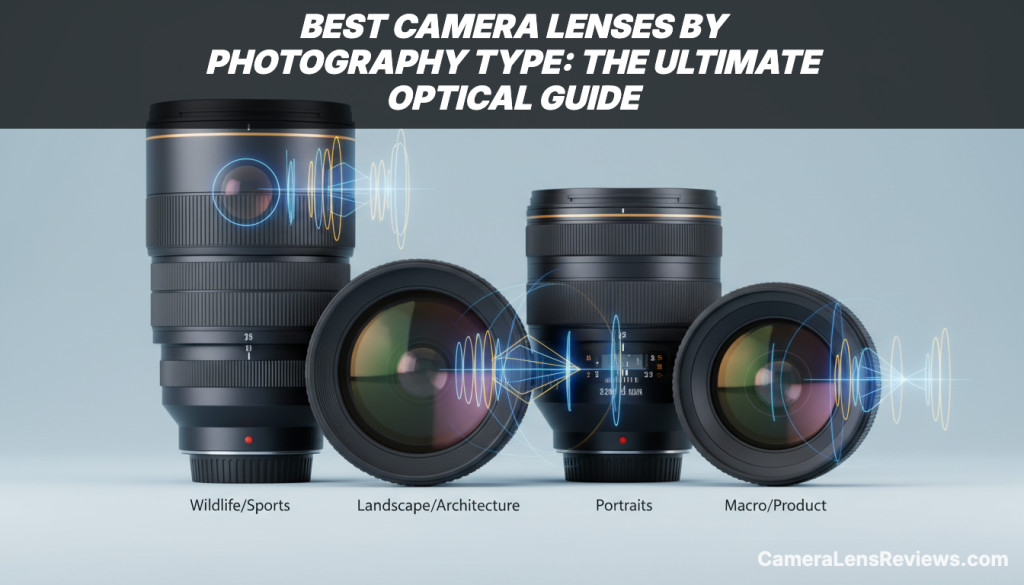
Choosing the right portrait lens is about defining your style. Do you need the dreamlike obliteration of backgrounds provided by the Canon f/1.2, or the clinical precision of the Sony GM? For a broader look at how these focal lengths fit into your kit, check out our breakdown of Best Camera Lenses by Photography Type. Ultimately, any lens on this list will provide a significant leap in quality over standard kit zooms, allowing you to capture portraits that truly resonate.
Frequently Asked Questions
What is the best focal length for portrait photography?
For traditional headshots and half-body portraits, 85mm is considered the gold standard. It offers a flattering compression that slims the face without the distortion of wide-angle lenses. For tighter headshots, 135mm is excellent, while 35mm or 50mm is preferred for environmental portraits.
Do I really need an f/1.2 or f/1.4 lens for portraits?
Not necessarily. While f/1.2 and f/1.4 lenses allow for extreme background blur and low-light performance, an f/1.8 lens is often lighter, sharper, and significantly cheaper, while still providing excellent subject separation.
Can I use a zoom lens like a 70-200mm for portraits?
Absolutely. A 70-200mm f/2.8 is a staple in professional portrait photography. Shooting at 200mm at f/2.8 creates incredible background compression and blur, often rivaling prime lenses.
Why are portrait lenses so expensive?
Portrait lenses, especially fast primes, require large, high-quality glass elements to gather light and correct optical aberrations. Precision engineering for autofocus motors and weather sealing also contributes to the cost.
Is a 50mm lens good for portraits?
Yes, a 50mm lens (often called a ‘Nifty Fifty’) is a great versatile portrait lens. It is excellent for full-body and waist-up shots, though you should be careful with tight headshots as it can slightly distort facial features if you get too close.