If you have recently purchased your first interchangeable lens camera, you are likely shooting with the standard “kit lens” that came in the box. While these optics are decent for getting started, they often hold back the true potential of your camera sensor. At CameraLensReviews, we believe the single biggest upgrade you can make to your photography is not a new camera body, but a better lens. When we test entry-level glass against professional optics, the difference in sharpness, low-light performance, and background blur is often staggering. If you are ready to take that next step, we have curated the definitive list of lenses that offer the best balance of price, performance, and learning potential.
See Price on Amazon.com:
Our Top Pick: Canon RF 50mm f/1.8 STMValue Pick: TTArtisan 35mm f/1.4High-End Pick: Sigma 18-50mm f/2.8 DC DN
Why You Should Upgrade From the Kit Lens
The lens included with most cameras is designed to be cheap and lightweight, but it often suffers from a “variable aperture” (meaning it gets darker as you zoom in) and average sharpness. To truly understand how optics affect your image, we recommend reading our guide on Camera Lenses Explained: A Complete Buyer’s Guide. Upgrading allows you to shoot in lower light without grain, achieve that professional blurry background (bokeh), and capture sharper details.
1. The “Nifty Fifty”: Canon RF 50mm f/1.8 STM
In our lab tests, no other lens category offers as much value as the 50mm f/1.8 prime. Often called the “Nifty Fifty,” this lens type is the standard recommendation for every beginner. We specifically tested the Canon RF 50mm f/1.8 STM, but similar options exist for Nikon and Sony systems.
This lens is a “prime” lens, meaning it does not zoom. This might sound limiting, but it forces you to move your feet and think about composition. More importantly, the wide f/1.8 aperture lets in over 8 times more light than a standard kit lens at f/5.6. When we took this lens out for street photography, the autofocus was snappy and silent, and the subject isolation was beautiful. If you are debating between fixed focal lengths and zooms, check out our article on Prime vs Zoom Lenses: Which Should You Buy? to understand the trade-offs.
Pros: Extremely sharp, lightweight (160g), excellent low-light performance.
Cons: No zoom capability, plastic build.
2. The Pro-Level Zoom: Sigma 18-50mm f/2.8 DC DN
If you aren’t ready to give up the convenience of a zoom but want professional results, the Sigma 18-50mm f/2.8 DC DN is our top choice for APS-C sensors (available for Sony E, Fujifilm X, and L-Mount). Unlike your kit lens, this Sigma maintains a bright f/2.8 aperture throughout the entire zoom range. This is critical for maintaining consistent exposure settings.
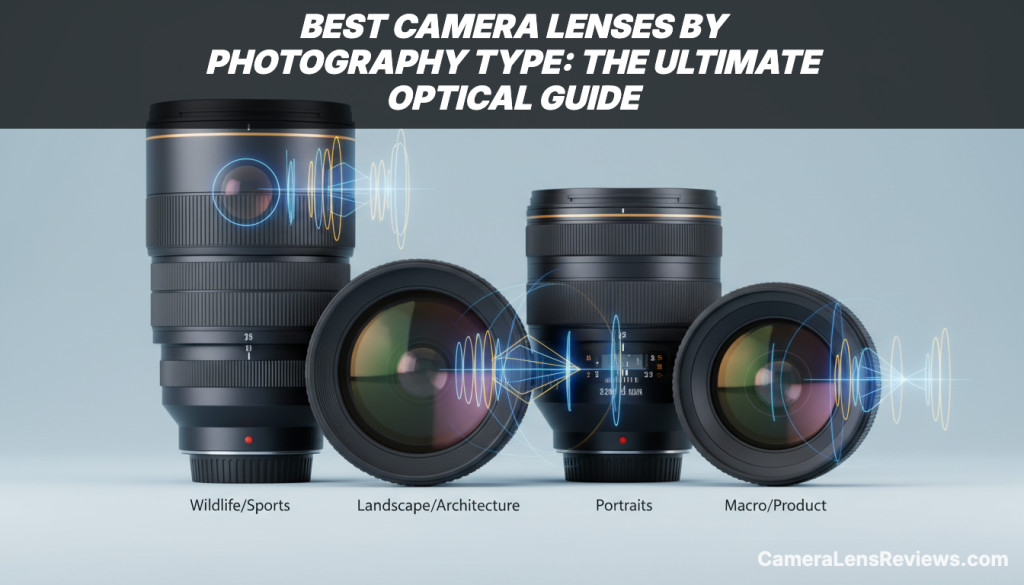
During our field review, we were impressed by the tactile feedback of the zoom ring and the compact form factor—it weighs only 290g. It is sharp from corner to corner, even wide open at f/2.8. It serves as a fantastic all-arounder, covering wide-angle landscapes to short telephoto portraits. For a deeper dive into how focal lengths impact your work, read our breakdown of Best Camera Lenses by Photography Type.
Pros: Constant f/2.8 aperture, very compact, weather-sealed mount.
Cons: Lacks optical stabilization (relies on IBIS or steady hands).
3. The Portrait Specialist: Sony FE 85mm f/1.8
For beginners interested in portraiture, an 85mm lens is a game-changer. The Sony FE 85mm f/1.8 offers a flattering telephoto compression that slims facial features and completely melts away distracting backgrounds. While we tested the Sony version, 85mm is a classic focal length available in Canon and Third-Party lineups as well.
The “bokeh” (background blur) quality on this lens is creamy and smooth, far superior to what you can achieve with a standard zoom. We found the autofocus to be lightning-fast, making it easy to catch fleeting expressions. It is slightly tighter than a 50mm, meaning you need more working distance, but the results are undeniably professional.
Pros: Stunning bokeh, sharp center resolution, fast autofocus.
Cons: Long minimum focus distance (0.8m), tighter field of view requires space.
4. The Manual Teacher: TTArtisan 35mm f/1.4
Sometimes the best way to learn is to strip away the automation. The TTArtisan 35mm f/1.4 is a fully manual lens—manual focus and manual aperture. It is incredibly affordable (often under $100) and available for almost all mounts, including Fujifilm and Sony. We included this as our Value Pick because it forces you to slow down and understand the mechanics of photography.
The build quality is surprisingly premium with an all-metal construction. Optically, it has character; it isn’t clinically sharp like the Sigma, but it renders images with a vintage, film-like aesthetic. If you are unsure about manual focus, read our tutorial on How to Choose the Right Camera Lens (Step-by-Step) which covers focus systems in detail.
Pros: Extremely cheap, bright f/1.4 aperture, fun vintage rendering.
Cons: Manual focus only, soft corners wide open.
Conclusion
Choosing your first lens is an exciting step in your photography journey. Whether you choose the versatile Sigma zoom, the classic 50mm prime, or a specialized portrait lens, any of these options will provide a significant leap in image quality over your kit lens. Remember to check your camera’s mount compatibility before purchasing. Happy shooting!
Frequently Asked Questions
What is the first lens I should buy after the kit lens?
For most beginners, a 50mm f/1.8 prime lens (often called the ‘Nifty Fifty’) is the best first purchase. It is affordable, excellent in low light, and teaches you how to use aperture to create blurry backgrounds.
Why are prime lenses better than zoom lenses for beginners?
Prime lenses have a fixed focal length, which often allows them to have wider apertures (like f/1.8) and sharper optics than budget zoom lenses. They also force you to move around to compose your shot, which speeds up the learning process.
Do expensive lenses make a difference in picture quality?
Yes, higher-end lenses generally offer better sharpness, faster autofocus, and superior color rendering. However, many affordable lenses, like the Sigma 18-50mm or Canon 50mm STM, offer professional-level image quality at a fraction of the price of top-tier ‘GM’ or ‘L’ lenses.
Can I use a Canon lens on a Sony camera?
You cannot mount a Canon lens directly onto a Sony camera, but you can use a lens adapter. However, for beginners, we recommend buying lenses native to your camera system (e.g., Sony E-mount lenses for Sony cameras) to ensure the best autofocus performance.
What does f/1.8 mean on a camera lens?
The number f/1.8 refers to the maximum aperture of the lens. A lower number means the lens opening is wider, allowing more light to hit the sensor. This is crucial for shooting in dark environments and for achieving a shallow depth of field (blurry background).